
Bulk merging needs guardrails, not just a bigger button
Selecting many pull requests should reduce repetitive work, not weaken the conditions required to merge each one.
On this page
A dependency bot opens a batch of updates. Some pass their checks, some need review, and one conflicts with a change already on the base branch. Opening every PR individually is repetitive work. Merging the entire batch without distinguishing those states is a different problem.
A useful bulk action removes repetition while preserving the requirements for each pull request. The selection describes what you want to consider. It should not become permission to bypass the rules.
Separate selection from eligibility
Start with a group that makes operational sense: updates in one repository, changes for a release, or a small set of independent fixes. Then evaluate each PR against its current state.
A practical checklist includes:
- The PR is still open and is not a draft.
- Required checks and reviews satisfy repository rules.
- The approved revision is still the revision being merged.
- There are no unresolved blockers or merge conflicts.
- The change is appropriate for the intended release.
The last point requires context that a green check may not contain. A technically mergeable feature may still need a coordinated launch or a deployment prerequisite.
Treat eligibility as temporary
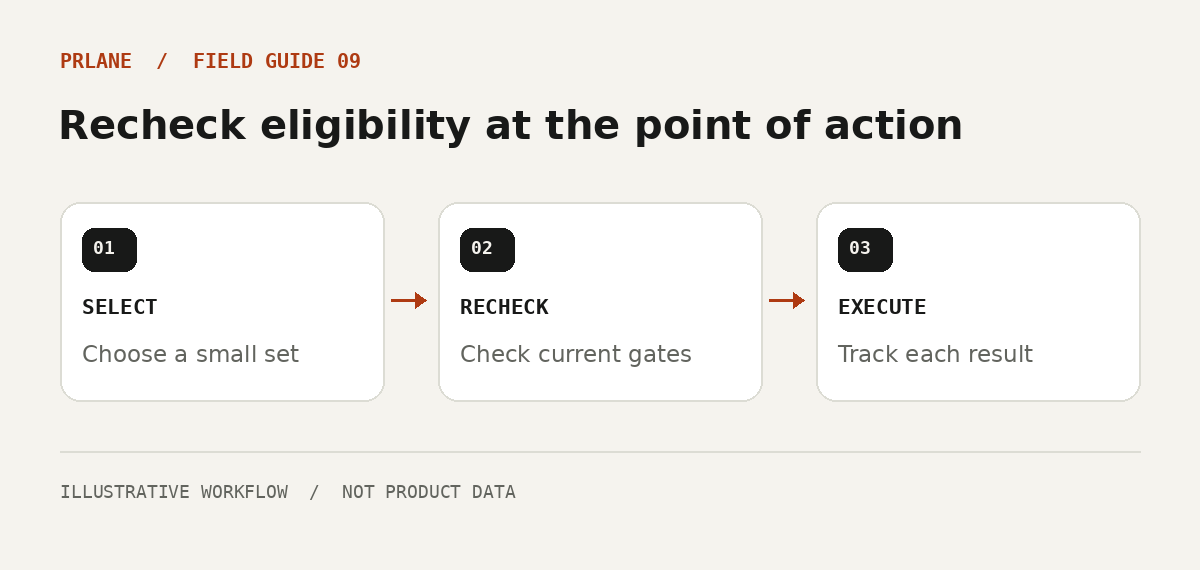
A dashboard reflects a moment in time. Between selecting a PR and merging it, someone may push another commit, request changes, or merge work into the base branch.
Re-check the relevant conditions at execution time. Do not use an earlier green status as permanent evidence. If the state changes, the safe outcome may be to stop or skip that PR and explain why.
PRLane's merge queue re-checks pull requests against GitHub before merging. The important principle is that batching must preserve fresh checks rather than turn an old snapshot into an unconditional instruction.
Look for dependencies inside the batch
Individually acceptable changes can still interact. Two updates may modify the same shared dependency. A database change may need to land before application code that uses the new structure. One PR may assume another has already merged.
For example, imagine a field rename and a reporting change that reads that field. Both could pass their isolated checks while depending on different assumptions about the final schema. Inspect the relationship and choose an appropriate order or combined validation plan.
Do not imply that selecting both automatically proves they work together. Your testing and merge strategy must address that question explicitly.
Decide how partial success should behave
A batch is not necessarily all-or-nothing. Define what happens when the first few PRs merge and the next one fails a check or develops a conflict.
The result should distinguish merged, skipped, and blocked work. A reviewer needs enough information to decide whether to retry, update a branch, investigate a failure, or remove a change from the batch. Avoid repeated blind retries that create activity without resolving the underlying issue.
Keep a recovery plan proportional to the change
Before a consequential batch, know how the team will identify what landed and respond if a problem appears. A revert may help, but it is not a universal undo button, especially when changes affect persistent data or external systems.
Bulk merging is most useful when the team can explain both why each PR is eligible and what happened afterward. Measure the reduction in repetitive handling without assuming that fewer clicks eliminate engineering responsibility.
Related guide: Merge Queues: Keeping Approved Work Moving as Main Changes.
Sign up for PRLane to manage your PR fleet with readiness and merge decisions in one place.