

Pull request workflow comparison
GitHub merge queue vs. PRLane: what changes across repositories?
GitHub’s native queue answers “can this change land safely on this branch?” PRLane answers “which pull requests across our repositories need action next?” Start with GitHub alone if the branch is your bottleneck. Add a shared fleet view if finding and moving work between repositories is the problem.
When GitHub alone is enough
If you mostly manage one busy protected branch and reviewers are already working in GitHub, use its native merge queue. GitHub checks a temporary merge group that combines the latest target branch with queued work ahead of the PR. Your required CI checks must report on this group; GitHub Actions workflows typically add the merge_group event. Each repository and target branch configures its own protection. Nothing there coordinates a release or runs tests across two repositories by itself.
What PRLane adds across repositories
The Fleet dashboard shows PRs from connected GitHub repositories in one view. You can group them by blockers such as review, failing checks, conflicts, and drafts, then select eligible work for shared actions such as requesting reviewers, labeling, or queueing. You still review and enforce policy on each repo.
PRLane’s own queue rechecks the queued commit and GitHub readiness before attempting a merge. It is not GitHub’s native merge group: it does not provide that combined-CI check and it does not bypass repository rules. If the branch requires GitHub’s queue, keep that queue as the final landing path; use PRLane for triage and finish queueing in GitHub. Cross-repository visibility is not an atomic cross-repository merge.
Try it: two real PRs, two different next actions
These are public GitHub observations captured on . The triage decisions are illustrative, not a claim that these projects use PRLane or that either repository requires a merge queue. The PRs’ current states may differ from the snapshot.
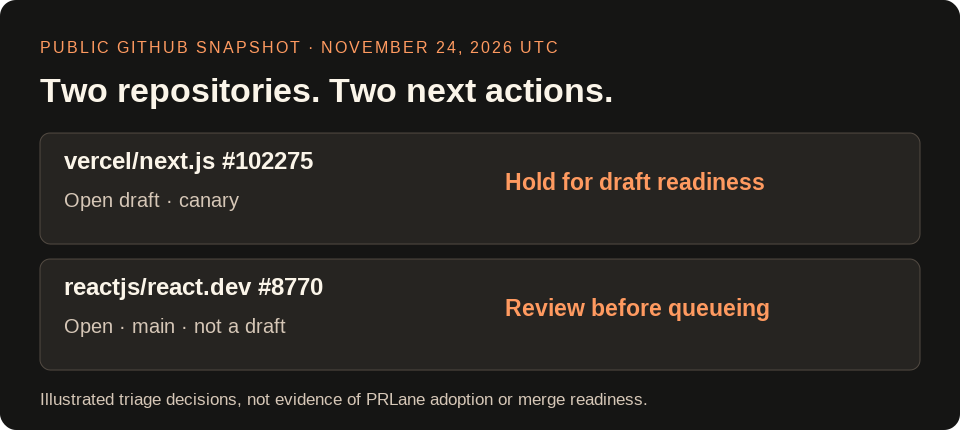
vercel/next.js #102275
Observed: Open draft, targeting
canary.Next action: Leave it out of the merge queue and wait for the author to mark it ready.
reactjs/react.dev #8770
Observed: Open, not a draft, targeting
main.Next action: Open it for review; confirm approvals and required checks before queueing.
To reproduce, open both links and check the draft badge and target branch on each. Treat a non-draft as a review candidate, not proof of merge readiness. Then follow the cross-repository triage guide using two repositories you’re already authorized to manage. Compare the decision you make on each PR, not the number of tabs you opened or any unmeasured time savings.